


Cách Phát Âm /b/ Trong Tiếng Anh: Hướng Dẫn Chuẩn Cho Người Mới

Âm /b/ xuất hiện trong rất nhiều từ tiếng Anh cơ bản như book, baby, table, job. Người Việt vốn đã quen với âm gần tương tự /b/ ở đầu từ, vì vậy đây thường không phải âm quá khó khi đứng một mình. Tuy nhiên, khi /b/ xuất hiện cuối từ, trong cụm phụ âm hoặc đứng đối lập với /p/, người học vẫn có thể phát âm chưa chính xác.
Thứ nhất, đọc /b/ gần thành /p/. Nếu /b/ bị phát âm quá căng hoặc mất các tín hiệu hữu thanh, bat /bæt/ có thể nghe gần với pat /pæt/, còn cab /kæb/ dễ bị nghe thành cap /kæp/.
Thứ hai, bỏ mất /b/ ở cuối từ. Trong tiếng Việt, /b/ không phải là một phụ âm cuối thông thường. Vì vậy, khi gặp những từ như job, club, web, cab, một số người học dễ kết thúc từ ngay sau nguyên âm thay vì hoàn thành động tác khép môi của /b/. Các nghiên cứu về người Việt học tiếng Anh cũng đã tập trung riêng vào những lỗi ở các phụ âm tắc cuối từ như /p/, /b/, /t/, /d/, /k/, /g/.
Thứ ba, thêm “bờ” sau /b/ cuối từ. Vì muốn làm phụ âm cuối nghe rõ hơn, người học đôi khi vô thức thêm một nguyên âm: job thành gần giống “job-bờ”, club thành “club-bờ”. Cách đọc này khiến từ xuất hiện thêm một âm tiết không có trong phiên âm gốc.
Thứ tư, chèn nguyên âm vào cụm phụ âm có /b/. Những từ như blue, black, bread, bring cần nối /b/ trực tiếp sang phụ âm tiếp theo. Nếu đọc thành “bờ-lu” hay “bờ-ring”, nhịp âm tiết của từ sẽ bị thay đổi.
Trong PTE Speaking, Pronunciation không yêu cầu bạn nói giống hệt người bản xứ. Điều quan trọng là lời nói rõ và dễ hiểu, trong thang mô tả của Pearson, mức Pronunciation cao nhất gắn với khả năng người nghe hiểu lời nói một cách dễ dàng.
Để luyện /b/ hiệu quả hơn, bài viết sẽ tập trung vào ba nội dung chính:
- Tạo đúng âm /b/: Hiểu cách hai môi hoạt động, cách sử dụng dây thanh và sự khác biệt cơ bản giữa /b/ với /p/.
- Nhận diện /b/ qua mặt chữ: Làm quen với chữ b, bb, vị trí của âm /b/ trong từ và những trường hợp chữ b không được phát âm.
- Luyện từ nghe đến nói: Củng cố khả năng nhận diện và tạo âm với các bài tập trong Skill Booster trên PTEUNI.
1. Giới thiệu về âm /b/
/b/ là một phụ âm hữu thanh, thuộc nhóm âm tắc (plosive/stop).
Khi tạo âm này, hai môi khép lại hoàn toàn để chặn luồng hơi trong thời gian rất ngắn. Sau đó, môi mở ra và luồng hơi được giải phóng.
2. Cách tạo âm /b/
Bạn có thể thực hành /b/ theo bốn bước đơn giản:
- Bước 1: Ép chặt hai môi vào nhau, kín hoàn toàn — giống hệt khẩu hình của /p/.
- Bước 2: Chặn luồng hơi lại phía sau môi trong một khoảnh khắc rất ngắn.
- Bước 3: Cho dây thanh rung — đây là điều làm nên /b/, và là điểm khác duy nhất so với /p/.
- Bước 4: Mở hai môi ra cho hơi thoát ra ngoài.
Hãy đọc chậm:
/b/ – /b/ – /b/
Khác với những âm xát như /s/, /f/ hay /v/, bạn không thể kéo /b/ thành một dòng hơi liên tục. /b/ là âm tắc, nên quá trình đóng – mở môi diễn ra khá nhanh.
Bạn có thể đặt tay lên cổ và thử so sánh:
/b/ → hữu thanh (rung cổ)
/p/ → vô thanh (không rung cổ)
Thử kiểm tra cách phát âm đúng bằng cách đặt bàn tay trước miệng rồi đọc:
bat – pat
Ở pat, /p/ đầu từ thường tạo một luồng hơi bật rõ hơn. Trong khi đó, /b/ trong bat được tạo nhẹ hơn và không có cú bật hơi mạnh tương tự.
Bạn có thể quan sát thêm chuyển động đóng – mở của hai môi trong video hướng dẫn từ giáo viên chuyên môn PTE Helper dưới đây.
3. Nhận diện âm /b/ qua mặt chữ
Mặt chữ phổ biến nhất của /b/ chính là chữ “b”. Âm này có thể xuất hiện ở đầu, giữa hoặc cuối từ.
- Đầu từ: bad, bag, baby, back, ball, bank, bed, big, book, business
- Giữa từ: about, table, number, mobile, habit, cabin, hobby, rubber, global, problem
- Cuối từ: cab, job, lab, web, club, rub, grab, tube, robe, describe
Dù chữ b thường tương ứng khá trực tiếp với /b/, tiếng Anh vẫn có một số trường hợp ngoại lệ mà bạn cần ghi nhớ.
Khi “bb” tạo âm /b/
Hai chữ bb thường vẫn chỉ tạo thành một phụ âm /b/.
Ví dụ:
- rabbit /ˈræbɪt/
- hobby /ˈhɒbi/
- rubber /ˈrʌbə/
- bubble /ˈbʌbəl/
- cabbage /ˈkæbɪdʒ/
- ribbon /ˈrɪbən/
Vì vậy, rabbit không có hai âm /b/ tách rời chỉ vì spelling chứa bb.
Khi chữ “b” đứng cuối từ
/b/ có thể là âm cuối thực sự trong nhiều từ:
- job /dʒɒb/
- club /klʌb/
- web /web/
- cab /kæb/
- rub /rʌb/
- grab /ɡræb/
- tube /tjuːb/
Điểm cần lưu ý là bạn không thêm nguyên âm sau /b/.
Ví dụ:
✅ job /dʒɒb/
❌ job-bờ
✅ club /klʌb/
❌ club-bờ
Khi chữ “b” là chữ câm
Không phải cứ nhìn thấy b là phải tạo /b/.
Một trường hợp rất phổ biến là b đứng sau m ở cuối một số từ, khi đó chữ b thường không được phát âm.
Ví dụ:
- lamb /læm/
- thumb /θʌm/
- comb /kəʊm/
- climb /klaɪm/
- bomb /bɒm/
- dumb /dʌm/
- numb /nʌm/
- tomb /tuːm/
Cambridge chẳng hạn ghi nhận lamb được phát âm /læm/, không có /b/ cuối.
Ngoài nhóm -mb, chữ b cũng không được phát âm trong một số từ như:
- doubt /daʊt/
- debt /det/
- subtle /ˈsʌtəl/
Cambridge thậm chí sử dụng chữ b trong doubt như một ví dụ điển hình cho silent letter – chữ viết nhưng không được phát âm.
Tuy nhiên, đừng biến điều này thành quy tắc “b đứng sau m luôn câm”.
Ví dụ:
number /ˈnʌmbə/ → vẫn có /b/
Vì vậy, khi gặp từ mới, cách an toàn nhất vẫn là kiểm tra IPA hoặc audio chuẩn.
4. Một vài lưu ý quan trọng về âm /b/
1. Phân biệt /b/ và /p/ không chỉ bằng độ rung
/b/ và /p/ có cùng khẩu hình: hai môi khép lại rồi mở ra.
Nhưng khi luyện, bạn có thể bắt đầu bằng những cặp như:
bat /bæt/ – pat /pæt/
bin /bɪn/ – pin /pɪn/
bear /beə/ – pear /peə/
buy /baɪ/ – pie /paɪ/
Ở đầu âm tiết có trọng âm, /p/ thường có một khoảng aspiration – luồng hơi bật rõ. /b/ thì không có kiểu bật hơi mạnh đó.
2. /b/ cuối từ không cần được “rung thật mạnh”
Khi /b/ đứng cuối những từ như:
cab, job, web, club
người học đôi khi cố kéo dài hoặc thêm “bờ” để chứng minh rằng mình đã đọc /b/.
Điều này không cần thiết.
Trong tiếng Anh tự nhiên, /b/ cuối có thể được tạo khá nhẹ và thậm chí bị vô thanh một phần. Một tín hiệu quan trọng giúp người nghe phân biệt cặp /b/ – /p/ nằm ở thời lượng của nguyên âm phía trước. Nguyên âm trước /b/ thường dài hơn nguyên âm trước /p/.
So sánh:
cab – cap
rib – rip
robe – rope
Vì vậy, với cab, bạn không cần tạo một tiếng “bờ” mạnh ở cuối. Hãy giữ nguyên âm đủ tự nhiên, khép môi để hình thành /b/ rồi kết thúc từ.
3. Không thêm nguyên âm vào cụm /bl/ và /br/
/b/ có thể đứng ngay trước các phụ âm khác:
/bl/
- black /blæk/
- blue /bluː/
- blame /bleɪm/
- blind /blaɪnd/
/br/
- bread /bred/
- bring /brɪŋ/
- brown /braʊn/
- break /breɪk/
Đừng biến:
❌ blue → “bờ-lu”
❌ bring → “bờ-ring”
Thay vào đó, hãy nối thẳng:
b → bl → blue
b → br → bring
/b/ chỉ đóng vai trò là một phụ âm trong cụm, không phải một âm tiết riêng.
4. Đừng đọc chữ “b” nếu nó thực sự là silent b
Đây là lỗi liên quan đến mặt chữ hơn là khẩu hình.
Nếu thấy:
thumb, lamb, climb, bomb
người mới có thể cố phát âm cả /m/ lẫn /b/ vì nhìn thấy hai chữ.
Nhưng:
thumb /θʌm/
không phải /θʌmb/
climb /klaɪm/
không phải /klaɪmb/
Tương tự:
doubt /daʊt/
không có /b/.
Khi học những nhóm từ này, hãy ghi nhớ âm thanh của cả từ, thay vì cố đọc từng chữ cái một.
5. Luyện tập âm /b/ trên PTEUNI
Với /b/, bài luyện tốt không chỉ giúp bạn “đọc ra âm”, mà còn phải giúp bạn nhận biết khi nào /b/ khác /p/, khi nào /b/ nằm cuối từ và khi nào chữ b hoàn toàn không được phát âm.
Bạn có thể bắt đầu trong Skill Booster trên PTEUNI với Identify the Sound. Khi nghe, hãy tập trung vào /b/ ở nhiều vị trí khác nhau và đặc biệt luyện các cặp đối lập như bat – pat, cab – cap.
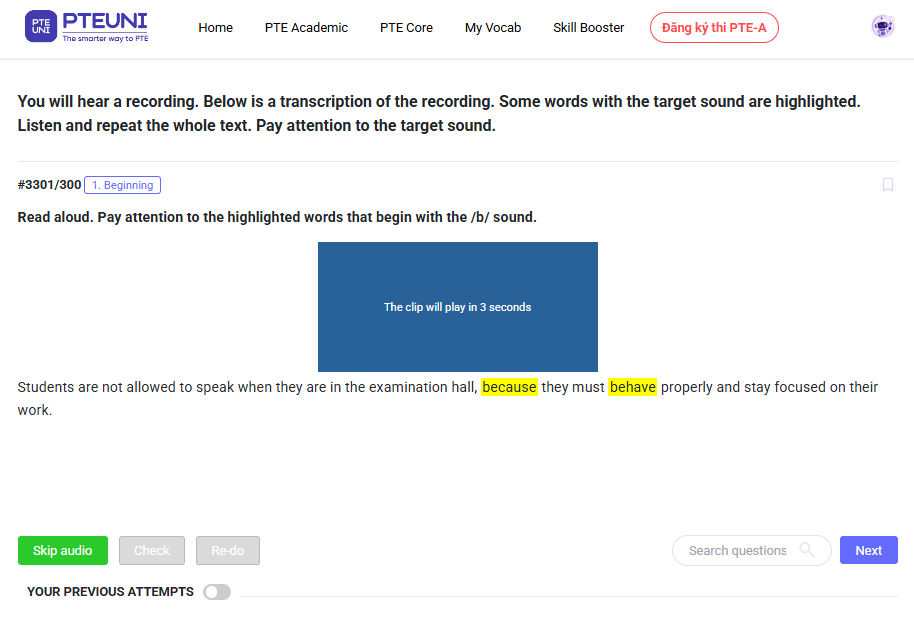
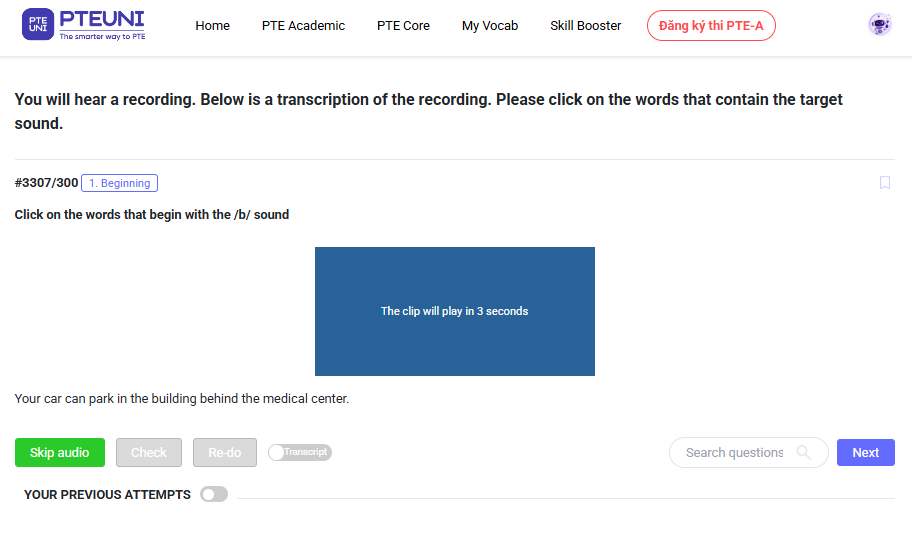
Sau khi khả năng nhận diện đã ổn định hơn, chuyển sang Practice the Sound để tự phát âm và kiểm tra lại cách hai môi đóng – mở.
Riêng với /b/, bạn có thể tự đặt ra bốn câu hỏi sau mỗi lượt luyện:
- Hai môi có khép hoàn toàn trước khi mở ra không?
- /b/ có bị bật hơi mạnh giống /p/ không?
- Khi /b/ nằm cuối từ, mình có bỏ âm hoặc thêm “bờ” không?
- Với các từ như thumb, lamb, doubt, mình có vô tình đọc cả chữ b không?
Một cách luyện dễ kiểm soát là chia từ thành từng nhóm:
/b/ đầu từ → /b/ giữa từ → /b/ cuối từ → /bl/, /br/ → silent b
Ví dụ:
book → baby → table → job → blue → bring → thumb
Cách sắp xếp này giúp bạn không chỉ luyện một khẩu hình cố định mà còn làm quen với cách /b/ thay đổi theo vị trí thực tế trong từ.
Nếu đang là học viên PTE Helper, bạn có thể vào PTEUNI → Skill Booster và sử dụng Identify the Sound cùng Practice the Sound để luyện thêm âm /b/: https://www.pteuni.com/
Với /b/, hãy bắt đầu bằng việc nhớ đúng cơ chế cơ bản: khép hai môi, giữ hơi trong khoảnh khắc ngắn rồi mở môi mà không tạo luồng bật mạnh như /p/. Sau đó, tập trung nhiều hơn vào những vị trí khó như /b/ cuối từ và các cụm bl-, br-.
Khi đã phân biệt chắc những cặp như bat – pat, cab – cap và không còn thêm “bờ” sau các từ như job, club, bạn có thể đưa /b/ vào câu dài và tăng tốc độ nói dần. PTE Helper sẽ tiếp tục đồng hành cùng bạn trong quá trình xây dựng nền tảng phát âm rõ ràng và chuẩn bị tốt hơn cho kỹ năng Speaking trong PTE.
Bạn có thể tìm hiểu thêm:
- Cách phát âm âm /v/ chuẩn trong tiếng Anh
- Tìm hiểu 44 âm tiếng Anh qua bảng phiên âm IPA
- Tổng hợp các quy tắc phát âm tiếng Anh quan trọng
- Bài tập khẩu hình giúp cải thiện phát âm ngay tại nhà
- Khóa học PTE Pronunciation: Luyện phát âm chuyên sâu cho người học PTE
How to Pronounce /b/ in English: A Complete Guide for Beginners
The /b/ sound appears in many basic English words such as book, baby, table, and job. Vietnamese speakers are already familiar with a similar /b/ sound at the beginning of words, so /b/ is generally not too difficult to produce in isolation. However, learners may still struggle to pronounce it accurately when /b/ occurs at the end of a word, in consonant clusters, or in contrast with /p/.
First, pronouncing /b/ too much like /p/. If /b/ is produced with too much tension or loses its voicing cues, bat /bæt/ may sound similar to pat /pæt/, while cab /kæb/ may be heard as cap /kæp/.
Second, dropping /b/ at the end of a word. In Vietnamese, /b/ is not a common final consonant. Therefore, when encountering words such as job, club, web, and cab, some learners may end the word immediately after the vowel instead of completing the lip closure required for /b/. Research on Vietnamese learners of English has also specifically examined difficulties with final stop consonants such as /p/, /b/, /t/, /d/, /k/, and /g/.
Third, adding a “buh” sound after final /b/. In an attempt to make the final consonant sound clearer, learners may unconsciously add a vowel after it: job may sound like “job-buh,” and club may sound like “club-buh.” This adds an extra syllable that does not exist in the original pronunciation.
Fourth, inserting a vowel into consonant clusters containing /b/. Words such as blue, black, bread, and bring require /b/ to connect directly to the following consonant. If you pronounce them as “buh-loo” or “buh-ring,” the syllable structure and rhythm of the word will change.
In PTE Speaking, Pronunciation does not require you to sound exactly like a native speaker. What matters is that your speech is clear and easy to understand. In Pearson’s scoring descriptors, the highest level of Pronunciation is associated with speech that can be understood easily by the listener.
To help you practice /b/ more effectively, this article focuses on three main areas:
- Producing /b/ correctly: Understand how the lips work, how to use your vocal cords, and the basic difference between /b/ and /p/.
- Recognizing /b/ in spelling: Become familiar with the letters b and bb, the position of /b/ within words, and cases where the letter b is silent.
- Practicing from listening to speaking: Strengthen your ability to recognize and produce the sound through exercises in Skill Booster on PTEUNI.
1. Introduction to the /b/ Sound
/b/ is a voiced consonant and belongs to the group of plosive (or stop) sounds.
When producing this sound, the lips close completely to block the airflow for a very brief moment. The lips then open and release the trapped air.
2. How to Produce the /b/ Sound
You can practice /b/ in four simple steps:
- Step 1: Press your lips firmly together, creating a complete closure, just as you would for /p/.
- Step 2: Briefly hold the airflow behind your lips.
- Step 3: Vibrate your vocal cords — this is what makes /b/ voiced and is the key difference between /b/ and /p/.
- Step 4: Open your lips and allow the air to escape.
Say the sound slowly:
/b/ – /b/ – /b/
Unlike fricative sounds such as /s/, /f/, or /v/, you cannot stretch /b/ into a continuous stream of air. /b/ is a stop sound, so the process of closing and opening the lips happens quite quickly.
You can place your hand on your throat and compare:
/b/ → voiced (you feel vibration)
/p/ → voiceless (no vibration)
Try checking your pronunciation by placing your hand in front of your mouth and saying:
bat – pat
In pat, the /p/ at the beginning of the word is typically accompanied by a clearer burst of air. In bat, on the other hand, /b/ is produced more gently and does not have the same strong aspiration.
You can also observe the closing and opening movement of the lips in the pronunciation tutorial from the professional teachers at PTE Helper below.
3. Identifying the /b/ Sound in Spelling
The most common spelling for /b/ is the letter “b.” The sound can appear at the beginning, middle, or end of a word.
- At the beginning of a word: bad, bag, baby, back, ball, bank, bed, big, book, business
- In the middle of a word: about, table, number, mobile, habit, cabin, hobby, rubber, global, problem
- At the end of a word: cab, job, lab, web, club, rub, grab, tube, robe, describe
Although the letter b usually corresponds quite directly to /b/, English still has some exceptions that you need to remember.
When “bb” Represents the /b/ Sound
The two letters bb usually still represent a single /b/ consonant.
For example:
- rabbit /ˈræbɪt/
- hobby /ˈhɒbi/
- rubber /ˈrʌbə/
- bubble /ˈbʌbəl/
- cabbage /ˈkæbɪdʒ/
- ribbon /ˈrɪbən/
Therefore, rabbit does not contain two separate /b/ sounds simply because its spelling contains bb.
When the Letter “b” Occurs at the End of a Word
/b/ can be a true final sound in many words:
- job /dʒɒb/
- club /klʌb/
- web /web/
- cab /kæb/
- rub /rʌb/
- grab /ɡræb/
- tube /tjuːb/
The key point is that you should not add a vowel after /b/.
For example:
✅ job /dʒɒb/
❌ job-buh
✅ club /klʌb/
❌ club-buh
When the Letter “b” Is Silent
You should not pronounce /b/ every time you see the letter b.
A very common example occurs when b follows m at the end of certain words. In these cases, the b is usually silent.
For example:
- lamb /læm/
- thumb /θʌm/
- comb /kəʊm/
- climb /klaɪm/
- bomb /bɒm/
- dumb /dʌm/
- numb /nʌm/
- tomb /tuːm/
For example, Cambridge gives lamb with the pronunciation /læm/, without a final /b/.
Beyond the -mb pattern, the letter b is also silent in some words such as:
- doubt /daʊt/
- debt /det/
- subtle /ˈsʌtəl/
Cambridge also uses the b in doubt as a typical example of a silent letter — a letter that appears in spelling but is not pronounced.
However, do not turn this into a rule that “b is always silent after m.”
For example:
number /ˈnʌmbə/ → the /b/ is still pronounced.
Therefore, when learning a new word, the safest approach is still to check its IPA transcription or a reliable audio recording.
4. Important Points to Remember About the /b/ Sound
1. Distinguishing /b/ and /p/ Is Not Just About Voicing
/b/ and /p/ use the same mouth position: the lips close and then open.
However, when practicing, you can start with minimal pairs such as:
bat /bæt/ – pat /pæt/
bin /bɪn/ – pin /pɪn/
bear /beə/ – pear /peə/
buy /baɪ/ – pie /paɪ/
At the beginning of a stressed syllable, /p/ typically has a period of aspiration — a noticeable burst of air. /b/, on the other hand, does not have the same strong burst of air.
2. Final /b/ Does Not Need to Be “Strongly Voiced”
When /b/ occurs at the end of words such as:
cab, job, web, club
learners sometimes try to prolong the sound or add “buh” to make it obvious that they have pronounced /b/.
This is unnecessary.
In natural English, final /b/ may be produced quite lightly and can even become partially devoiced. One important cue that helps listeners distinguish /b/ from /p/ is the duration of the preceding vowel. The vowel before /b/ is often longer than the vowel before /p/.
Compare:
cab – cap
rib – rip
robe – rope
Therefore, with cab, you do not need to produce a strong “buh” sound at the end. Keep the vowel at a natural length, close your lips to form /b/, and finish the word.
3. Do Not Insert a Vowel into /bl/ and /br/ Clusters
/b/ can occur directly before other consonants:
/bl/
- black /blæk/
- blue /bluː/
- blame /bleɪm/
- blind /blaɪnd/
/br/
- bread /bred/
- bring /brɪŋ/
- brown /braʊn/
- break /breɪk/
Do not turn:
❌ blue → “buh-loo”
❌ bring → “buh-ring”
Instead, connect the sounds directly:
b → bl → blue
b → br → bring
/b/ is simply one consonant within the cluster, not a separate syllable.
4. Do Not Pronounce “b” When It Is a Silent Letter
This is more of a spelling-related issue than a mouth-position problem.
When learners see words such as:
thumb, lamb, climb, bomb
they may try to pronounce both /m/ and /b/ because both letters appear in the spelling.
However:
thumb /θʌm/
not /θʌmb/
climb /klaɪm/
not /klaɪmb/
Similarly:
doubt /daʊt/
does not contain /b/.
When learning these word groups, focus on remembering the pronunciation of the whole word, rather than trying to pronounce each individual letter.
5. Practice the /b/ Sound on PTEUNI
With /b/, effective practice should not only help you “produce the sound.” It should also help you recognize when /b/ differs from /p/, when /b/ occurs at the end of a word, and when the letter b is completely silent.
You can start with Identify the Sound in Skill Booster on PTEUNI. As you listen, focus on /b/ in different positions and especially practice contrasting pairs such as bat – pat and cab – cap.
Once your recognition skills become more stable, move on to Practice the Sound to produce the sound yourself and check how your lips close and open.
For /b/, ask yourself these four questions after each practice session:
- Do my lips close completely before opening?
- Am I producing /b/ with a strong burst of air like /p/?
- When /b/ occurs at the end of a word, am I dropping it or adding “buh” afterward?
- In words such as thumb, lamb, and doubt, am I accidentally pronouncing the letter b?
An easy way to practice is to divide the words into groups:
/b/ at the beginning of a word → /b/ in the middle of a word → /b/ at the end of a word → /bl/, /br/ → silent b
For example:
book → baby → table → job → blue → bring → thumb
This approach helps you practice not only one fixed mouth position but also become familiar with how /b/ behaves in different positions within actual words.
If you are a PTE Helper student, you can go to PTEUNI → Skill Booster and use Identify the Sound and Practice the Sound to practice the /b/ sound further:
For /b/, start by remembering the basic mechanism: close your lips, briefly hold the airflow, and then open your lips without producing the strong burst of air associated with /p/. Next, focus more on challenging positions such as final /b/ and the bl- and br- clusters.
Once you can confidently distinguish pairs such as bat – pat and cab – cap and no longer add “buh” after words such as job and club, you can gradually incorporate /b/ into longer sentences and increase your speaking speed.
PTE Helper will continue to support you as you build a clear pronunciation foundation and prepare more effectively for the Speaking section of the PTE.













 Đăng ký tư vấn ngay