


Cách Phát Âm /d/ Đúng Và Dễ Nhớ Trong Tiếng Anh

Âm /d/ có mặt trong rất nhiều từ tiếng Anh quen thuộc như day, do, ready, good. Tuy nhiên, đây cũng là âm dễ bị đặt sai vị trí lưỡi, thiếu độ rung hoặc mất âm ở cuối từ — chỉ một thay đổi nhỏ cũng khiến từ bạn nói nghe không còn chính xác.
Thứ nhất, đặt lưỡi sai vị trí khiến /d/ nghe thành /ð/. Nếu phát âm /ð/ thay vì /d/, ladder sẽ nghe thành lather, breeding thành breathing.
Thứ hai, đọc /d/ thành /t/ do dây thanh không rung đủ. Khi /d/ đứng cuối từ, nhiều người quên rung dây thanh nên card nghe thành cart, bed thành bet. Lỗi này cũng xảy ra ở đầu từ: do /duː/ nghe gần giống two /tuː/.
Trong PTE Speaking, phát âm rõ nguyên âm và phụ âm là một phần của tiêu chí Pronunciation, và Pearson cũng nhấn mạnh mức độ dễ hiểu của lời nói khi đánh giá phát âm.
Qua bài hướng dẫn này, bạn sẽ từng bước làm quen với âm /d/ theo ba hướng chính:
- Hiểu cách tạo /d/: Biết lưỡi cần đặt ở đâu, dây thanh hoạt động thế nào và cách kiểm tra xem mình đã phát âm đúng hay chưa.
- Nhìn mặt chữ và nhận ra âm /d/: Làm quen với cách viết thường tạo ra /d/ ở vị trí đầu, giữa hoặc cuối từ.
- Chuyển từ học lý thuyết sang thực hành: Tiếp tục rèn khả năng nghe và phát âm với các bài luyện trong Skill Booster trên PTEUNI.
Lưu ý: Bài viết được trình bày bằng cả tiếng Việt và tiếng Anh. Nếu bạn sử dụng phiên bản tiếng Anh, vui lòng kéo xuống bên dưới để theo dõi nội dung.
Note: This article is available in both Vietnamese and English. If you prefer the English version, please scroll down to read the content.
1. Giới thiệu về âm /d/
/d/ là một phụ âm hữu thanh — khi phát âm, dây thanh trong cổ họng rung lên. Đây cũng là âm bật (plosive): lưỡi chặn hơi lại trong miệng một chút, rồi bật ra để tạo thành âm. /d/ có cùng vị trí lưỡi với /t/, chỉ khác là /d/ có rung còn /t/ thì không.
2. Cách tạo âm /d/
Bạn có thể luyện /d/ theo ba bước sau:
- Bước 1: Đưa đầu lưỡi lên gờ lợi ngay phía sau răng cửa trên. Lưỡi chạm vào phần lợi này — không chạm mặt sau của răng cửa trên và không đưa lưỡi ra giữa hai hàm răng.
- Bước 2: Giữ vị trí đó trong chốc lát để chặn luồng hơi trong miệng.
- Bước 3: Giữ cho dây thanh rung, rồi nhả lưỡi nhanh khỏi gờ lợi để hoàn thành âm /d/.
Tiếp theo, hãy quan sát khẩu hình và luyện theo video của giáo viên chuyên môn PTE Helper để dễ hình dung chính xác hơn cách tạo âm /d/.
3. Nhận diện âm /d/ qua mặt chữ
Âm này có thể xuất hiện ở nhiều vị trí khác nhau trong từ.
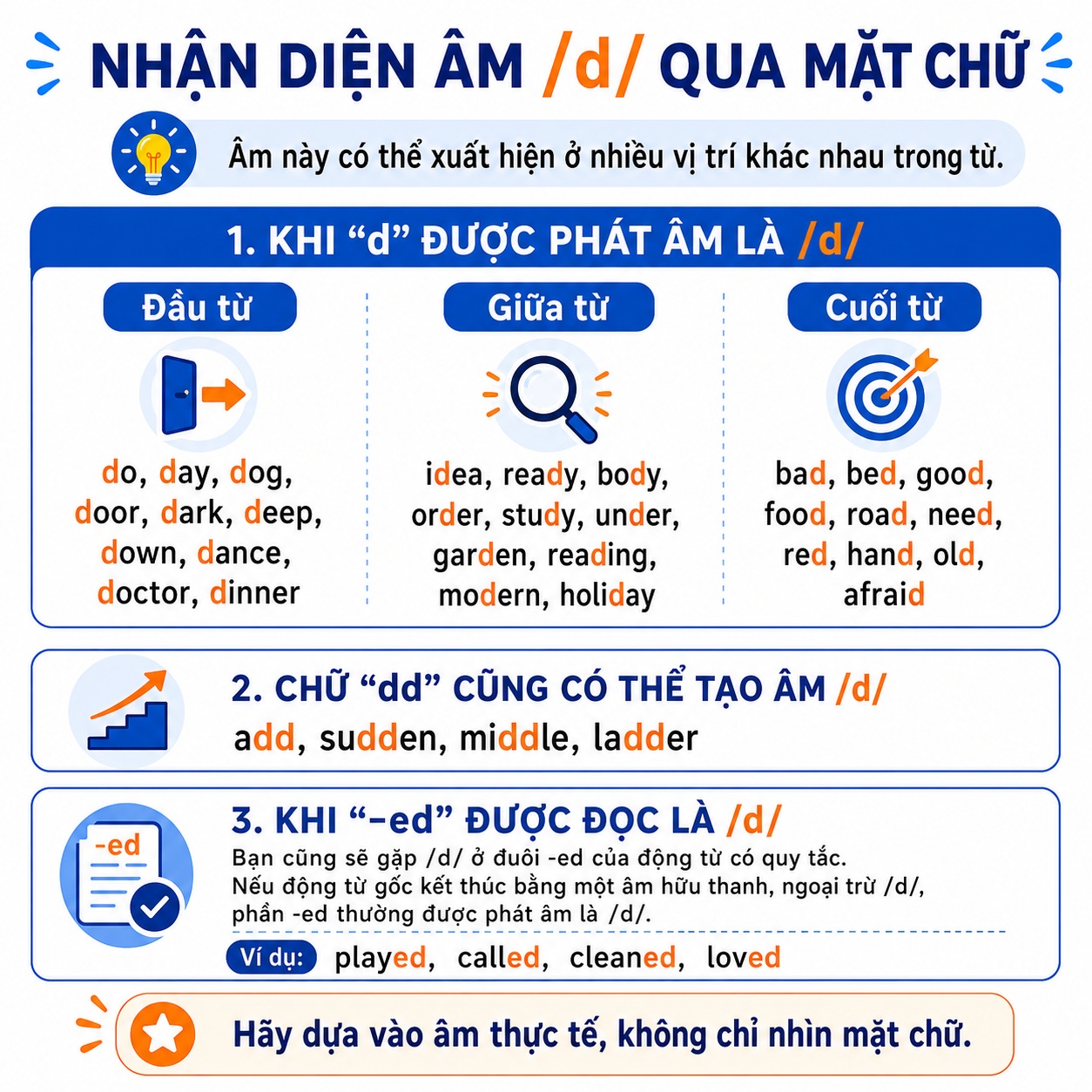
Khi “d” được phát âm là /d/, bạn có thể gặp các từ như:
- Đầu từ: do, day, dog, door, dark, deep, down, dance, doctor, dinner
- Giữa từ: idea, ready, body, order, study, under, garden, reading, modern, holiday
- Cuối từ: bad, bed, good, food, road, need, red, hand, old, afraid
Ngoài chữ d, hai chữ dd cũng có thể biểu thị một âm /d/, chẳng hạn: add, sudden, middle, ladder.
- Khi “-ed” được đọc là /d/:
Bạn cũng sẽ gặp /d/ ở đuôi -ed của động từ có quy tắc.
Nếu động từ gốc kết thúc bằng một âm hữu thanh, ngoại trừ /d/, phần -ed thường được phát âm là /d/.
Ví dụ:
- play → played /pleɪd/
- clean → cleaned /kliːnd/
- call → called /kɔːld/
- live → lived /lɪvd/
- love → loved /lʌvd/
Ở đây, điều quyết định cách đọc không phải chữ cái cuối cùng, mà là âm cuối của động từ gốc. Ví dụ, love kết thúc bằng âm /v/. Vì /v/ là âm hữu thanh nên loved kết thúc bằng /d/.
Ngược lại, nếu động từ kết thúc bằng chính âm /d/, chẳng hạn need, đuôi -ed tạo thêm một âm tiết: needed /ˈniːdɪd/
Vì vậy, khi gặp đuôi -ed, hãy tập thói quen nghe và xác định âm cuối của từ gốc trước khi quyết định đọc /t/, /d/ hay /ɪd/.
4. Một vài lưu ý quan trọng về âm /d/
Khi mới luyện, bạn nên tạo /d/ đủ rõ để hình thành đúng khẩu hình. Tuy nhiên, trong giao tiếp tự nhiên, âm này có thể thay đổi nhẹ tùy vị trí và giọng tiếng Anh.
- /d/ và /t/ có cùng vùng đặt lưỡi nhưng khác nhau về độ rung.
Vì vậy, chỉ đặt lưỡi đúng vẫn chưa đủ. Nếu dây thanh không hoạt động đúng, /d/ có thể nghe gần với /t/. Khi luyện các cặp như do – two hay den – ten, hãy chú ý cả vị trí lưỡi lẫn cảm giác rung ở cổ. - /d/ ở cuối từ không đọc thành “đờ”.
Trong các từ như good, bad, need, bạn chỉ cần hoàn thành đúng phụ âm cuối, không thêm một nguyên âm để cố làm /d/ rõ hơn.
Ví dụ:
✅ good
❌ good-“đờ”
Thực tế, dấu hiệu giúp người nghe nhận ra /d/ cuối từ nằm ở nguyên âm phía trước dài hơn so với khi đứng trước /t/. Đó mới là điểm phân biệt bed và bet, chứ không phải việc bật /d/ thật mạnh.
- Trong American English, /d/ ở một số vị trí có thể được phát âm rất nhanh.
Khi nằm giữa hai nguyên âm và âm tiết phía sau không mang trọng âm (ready, body, medal), /d/ có thể được thực hiện bằng một động tác chạm lưỡi nhanh gọi là alveolar tap [ɾ]. Hiện tượng này xảy ra với cả /t/ và /d/ — vì vậy trong giọng Mỹ, ladder và latter nghe gần như nhau. Giọng Úc cũng có hiện tượng tương tự, nên bạn sẽ gặp khá thường xuyên khi luyện nghe.
Đây là kiến thức mở rộng. Nếu mới bắt đầu, bạn chưa cần cố bắt chước các biến thể này.
5. Luyện tập âm /d/ trên PTEUNI
Hiểu được khẩu hình mới chỉ là bước đầu. Để /d/ trở thành một phần tự nhiên trong cách nói, bạn cần nghe âm nhiều lần, tự phát âm và kiểm tra lại kết quả của mình.
Với dạng bài Identify the Sound, bạn sẽ nghe và tập nhận biết âm /d/ trong các vị trí từ và ngữ cảnh khác nhau. Sau đó, dạng bài Practice the Sound giúp bạn chuyển sang luyện đọc để kiểm tra khả năng tạo âm của chính mình.
Cách luyện theo trình tự: Nghe → Nhận diện → Phát âm → Kiểm tra → Luyện lại sẽ hữu ích hơn việc chỉ nhìn một danh sách từ rồi đọc lặp lại, bởi bạn vừa rèn khả năng phân biệt âm bằng tai, vừa có cơ hội điều chỉnh cách phát âm của mình.
Bên cạnh nội dung phát âm, PTEUNI còn có các hoạt động hỗ trợ người học củng cố từ vựng, ngữ pháp và những kỹ năng cần thiết trong quá trình luyện thi PTE. Nhờ đó, bạn có thể kết hợp việc xây nền tiếng Anh với quá trình làm quen và luyện tập cho bài thi.
Học viên PTE Helper có thể truy cập PTEUNI và vào mục Skill Booster để bắt đầu luyện âm /d/ với các bài Identify the Sound và Practice the Sound: https://www.pteuni.com/
Mỗi lần luyện đúng là thêm một lần cơ miệng ghi nhớ cách tạo âm. Duy trì đều đặn sẽ giúp /d/ ngày càng rõ và tự nhiên mà không cần phải suy nghĩ quá nhiều khi nói. PTE Helper sẽ tiếp tục đồng hành cùng bạn trong quá trình xây dựng nền tảng phát âm và chuẩn bị cho mục tiêu PTE.
Các bài viết bạn không thể bỏ lỡ:
- Hướng dẫn phát âm 44 âm trong bảng IPA
- Các quy tắc phát âm tiếng Anh quan trọng
- 3 bài tập khẩu hình giúp cải thiện phát âm tại nhà
- Khóa học phát âm chuyên sâu PTE Pronunciation
- Xu hướng học PTE để du học và làm việc
How to Pronounce the /d/ Sound Correctly in English
The /d/ sound appears in many familiar English words, such as day, do, ready, and good. However, it is also a sound that learners often produce with incorrect tongue placement, insufficient voicing, or even drop at the end of a word — and even a small change can make the word sound inaccurate.
First, incorrect tongue placement can make /d/ sound like /ð/. If you pronounce /ð/ instead of /d/, ladder can sound like lather, and breeding can sound like breathing.
Second, /d/ can be pronounced as /t/ when the vocal cords do not vibrate enough. When /d/ occurs at the end of a word, many learners forget to voice it, so card can sound like cart, and bed can sound like bet. The same issue can occur at the beginning of a word: do /duː/ may sound similar to two /tuː/.
In PTE Speaking, clear pronunciation of both vowels and consonants is part of the Pronunciation criterion, and Pearson also emphasizes speech intelligibility when assessing pronunciation.
In this guide, you will gradually become familiar with the /d/ sound through three main areas:
- Understanding how to produce /d/: Learn where to place your tongue, how your vocal cords work, and how to check whether you are producing the sound correctly.
- Recognizing /d/ from spelling: Learn which spelling patterns commonly represent /d/ at the beginning, middle, or end of a word.
- Moving from theory to practice: Continue developing your listening and pronunciation skills through practice activities in Skill Booster on PTEUNI.
1. Introduction to the /d/ Sound
/d/ is a voiced consonant — your vocal cords vibrate when you produce it. It is also a plosive sound: the tongue briefly blocks the airflow in the mouth and then releases it to produce the sound. /d/ is produced with the same tongue position as /t/; the difference is that /d/ is voiced, while /t/ is voiceless.
2. How to Produce the /d/ Sound
You can practise producing /d/ in three steps:
- Step 1: Raise the tip of your tongue to the alveolar ridge just behind your upper front teeth. Your tongue should make contact with this ridge — not with the back of your upper front teeth, and it should not protrude between your teeth.
- Step 2: Hold this position briefly to stop the airflow in your mouth.
- Step 3: Keep your vocal cords vibrating, then quickly release your tongue from the alveolar ridge to complete the /d/ sound.
Next, watch the mouth position and follow along with the pronunciation video by a PTE Helper instructor to get a clearer idea of exactly how to produce the /d/ sound.
[VIDEO: HOW TO PRONOUNCE /d/]
3. Recognizing the /d/ Sound from Spelling
The /d/ sound can appear in different positions within a word.
When the letter “d” is pronounced as /d/, you may encounter words such as:
- At the beginning of a word: do, day, dog, door, dark, deep, down, dance, doctor, dinner
- In the middle of a word: idea, ready, body, order, study, under, garden, reading, modern, holiday
- At the end of a word: bad, bed, good, food, road, need, red, hand, old, afraid
In addition to the letter d, the letters dd can also represent a /d/ sound, for example: add, sudden, middle, ladder.
When “-ed” is pronounced /d/
You will also encounter /d/ in the -ed ending of regular verbs.
If the base verb ends in a voiced sound other than /d/, the -ed ending is usually pronounced /d/.
For example:
- play → played /pleɪd/
- clean → cleaned /kliːnd/
- call → called /kɔːld/
- live → lived /lɪvd/
- love → loved /lʌvd/
Here, what determines the pronunciation is not the final letter, but the final sound of the base verb. For example, love ends in the /v/ sound. Since /v/ is voiced, loved ends in /d/.
In contrast, if the verb ends in the /d/ sound itself, such as need, the -ed ending creates an additional syllable: needed /ˈniːdɪd/.
Therefore, when you encounter an -ed ending, get into the habit of listening to and identifying the final sound of the base verb before deciding whether to pronounce the ending as /t/, /d/, or /ɪd/.
4. Important Notes About the /d/ Sound
When you are just starting to practise, you should produce /d/ clearly so that you can develop the correct mouth position. However, in natural speech, this sound may vary slightly depending on its position and the variety of English being spoken.
-
/d/ and /t/ have the same tongue placement but differ in voicing.
Therefore, getting the tongue position right is not enough. If your vocal cords do not vibrate properly, /d/ may sound like /t/. When practising pairs such as do – two or den – ten, pay attention to both your tongue position and the vibration you feel in your throat.
-
/d/ at the end of a word is not pronounced as “duh.”
In words such as good, bad, and need, you simply need to complete the final consonant correctly. Do not add a vowel sound in an attempt to make the /d/ clearer.
For example:
✅ good
❌ good-“duh”In fact, one of the cues that helps listeners identify final /d/ is that the preceding vowel is longer than it is before /t/. This is an important part of what distinguishes bed from bet, rather than simply releasing the /d/ more strongly.
-
In American English, /d/ can be pronounced very quickly in certain positions.
When it occurs between two vowels and the following syllable is unstressed (ready, body, medal), /d/ may be produced as a quick tongue tap called an alveolar tap [ɾ]. The same phenomenon can occur with /t/ and /d/ — which is why, in American English, ladder and latter can sound almost identical. A similar phenomenon occurs in Australian English, so you may encounter it quite often when practising listening.
This is an advanced point. If you are just starting out, you do not need to try to imitate these variations.
5. Practising the /d/ Sound on PTEUNI
Understanding the mouth position is only the first step. To make /d/ a natural part of your speech, you need to listen to the sound repeatedly, produce it yourself, and check your results.
With the Identify the Sound activity, you will listen and practise identifying the /d/ sound in different word positions and contexts. Then, the Practice the Sound activity allows you to move on to pronunciation practice and check your ability to produce the sound yourself.
The sequence Listen → Identify → Pronounce → Check → Practise Again can be more effective than simply looking at a list of words and repeating them, because it helps you develop both your ability to distinguish sounds by ear and your ability to adjust your own pronunciation.
In addition to pronunciation content, PTEUNI also offers activities that help learners strengthen their vocabulary, grammar, and other skills needed throughout their PTE preparation. This allows you to build your English foundation while becoming familiar with and practising for the test.
PTE Helper students can access PTEUNI and go to Skill Booster to start practising the /d/ sound with the Identify the Sound and Practice the Sound activities: PTEUNI
Every time you practise correctly, you give your speech muscles another opportunity to build the right sound pattern. With consistent practice, your /d/ will become clearer and more natural, without requiring you to think too much about it while speaking. PTE Helper will continue to support you as you build a strong pronunciation foundation and work toward your PTE goals.














 Đăng ký tư vấn ngay