


Cách Phát Âm /f/ Trong Tiếng Anh: Chuẩn Khẩu Hình Cho Người Mới

Âm /f/ không quá xa lạ với người Việt vì chúng ta cũng có âm gần tương tự trong những từ như “phim”, “phở”. Tuy nhiên, khi chuyển sang tiếng Anh, /f/ có thể đứng ở nhiều vị trí hơn, đặc biệt là cuối từ và trong cụm phụ âm. Đây cũng là lúc người học dễ phát âm chưa rõ hoặc biến /f/ thành một âm khác.
Thứ nhất, đọc /f/ thành /h/ do không cho răng chạm môi. Nếu hai môi để hở và răng cửa trên không chạm vào môi dưới, luồng hơi thoát ra tự do và chỉ tạo thành một tiếng thở nhẹ giống /h/. Khi đó fat /fæt/ sẽ nghe thành hat /hæt/.
Thứ hai, đọc /f/ thành /p/ do khép cả hai môi. Thay vì để hơi ma sát liên tục qua môi và răng, người học khép hai môi lại để kết thúc từ như /p/: cuff /kʌf/ nghe thành cup /kʌp/, leaf /liːf/ nghe gần với leap /liːp/.
Thứ ba, đọc /f/ thành /v/ do làm rung dây thanh. /f/ và /v/ có khẩu hình gần như giống nhau, nhưng /f/ là âm vô thanh còn /v/ là âm hữu thanh. Nếu vô tình tạo độ rung, fan /fæn/ có thể nghe thành van /væn/, hay fine /faɪn/ gần thành vine /vaɪn/.
Thứ tư, bỏ hoặc làm quá yếu /f/ ở cuối từ. Những từ như life, half, roof, safe sẽ kém rõ ràng nếu người nói kết thúc ngay sau nguyên âm mà không giữ được phần ma sát của /f/.
Thứ năm, thêm nguyên âm khi /f/ đứng trong cụm phụ âm, chẳng hạn tách free thành gần giống “fờ-ri”. Việc này làm thay đổi nhịp và số âm tiết của từ.
Trong PTE Speaking, Pronunciation được đánh giá dựa trên mức độ rõ và dễ hiểu của nguyên âm, phụ âm cũng như toàn bộ lời nói. Ở mức cao nhất, Pearson mô tả yêu cầu là tất cả nguyên âm và phụ âm được tạo ra theo cách mà người nói tiếng Anh thông thường có thể hiểu dễ dàng.
Trong bài này, bạn sẽ làm quen với /f/ theo ba hướng chính:
- Nắm đúng khẩu hình /f/: Biết răng và môi đặt ở đâu, hơi thoát ra như thế nào và cách kiểm tra dây thanh.
- Nhận diện /f/ trong từ: Làm quen với các mặt chữ thường tạo ra /f/ và vị trí của âm trong từ.
- Đưa kiến thức vào thực hành: Luyện nghe, phân biệt và tự phát âm /f/ với Skill Booster trên PTEUNI.
1. Giới thiệu về âm /f/
/f/ là một phụ âm vô thanh, nghĩa là dây thanh không rung khi bạn phát âm.
Đây cũng là một âm xát (fricative). Khi tạo /f/, răng cửa trên và môi dưới tạo thành một khe hẹp để luồng hơi đi qua liên tục và tạo ra tiếng ma sát.
2. Cách tạo âm /f/
Bạn có thể luyện khẩu hình /f/ theo bốn bước:
- Bước 1: Thả lỏng hàm và đưa môi dưới lên chạm nhẹ vào mép răng cửa trên. Không cần cắn mạnh vào môi.
- Bước 2: Giữ điểm tiếp xúc thật nhẹ — đủ nhẹ để hơi vẫn lách qua được giữa răng và môi. Nếu ép chặt, hơi sẽ bị chặn hoàn toàn và âm không ra được.
- Bước 3: Đẩy hơi ra liên tục và đều qua chỗ tiếp xúc đó để tạo tiếng ma sát: /fffffff/.
- Bước 4: Giữ dây thanh không rung trong suốt quá trình phát âm.
Cách kiểm tra nhanh nhất: hãy cảm nhận răng cửa trên chạm vào môi dưới. Chỉ cần thấy rõ điểm tiếp xúc đó, /f/ của bạn đã đi đúng hướng.
Tiếp theo, hãy xem video hướng dẫn của giáo viên chuyên môn PTE Helper và luyện theo từng động tác để kiểm tra xem răng và môi của bạn đã đặt đúng vị trí chưa.
3. Nhận diện âm /f/ qua mặt chữ
Mặt chữ quen thuộc nhất của /f/ là f, nhưng đây không phải cách viết duy nhất. Âm /f/ còn có thể được tạo bởi ff, ph và trong một số từ là gh.
Khi chữ “f” được phát âm là /f/
Âm /f/ có thể xuất hiện ở đầu, giữa hoặc cuối từ:
- Đầu từ: fan, fine, fish, food, face, family, famous, future, follow, first
- Giữa từ: before, after, perfect, prefer, profile, refer, useful, careful
- Cuối từ: if, leaf, roof, safe, life, half, chief, proof, self, golf
Khi luyện, hãy dựa vào âm thực tế của từ, không chỉ nhìn vị trí của chữ f.
Khi “ff” tạo ra /f/
Hai chữ ff thường vẫn chỉ đại diện cho một âm /f/:
- coffee /ˈkɒfi/
- office /ˈɒfɪs/
- offer /ˈɒfə(r)/
- effect /ɪˈfekt/
- different /ˈdɪfrənt/
- difficult /ˈdɪfɪkəlt/
- cliff /klɪf/
- stuff /stʌf/
Bạn không cần đọc /f/ hai lần chỉ vì nhìn thấy hai chữ f.
Khi “ph” được phát âm là /f/
ph là một cách viết rất phổ biến của âm /f/, đặc biệt trong những từ có nguồn gốc Hy Lạp:
- phone /fəʊn/
- photo /ˈfəʊtəʊ/
- phrase /freɪz/
- physics /ˈfɪzɪks/
- pharmacy /ˈfɑːməsi/
- elephant /ˈelɪfənt/
- alphabet /ˈælfəbet/
- graph /ɡrɑːf/
Khi “gh” được phát âm là /f/
Một số từ quen thuộc có gh nhưng phần này lại được phát âm là /f/:
- laugh /lɑːf/
- cough /kɒf/
- rough /rʌf/
- tough /tʌf/
- enough /ɪˈnʌf/
Tuy nhiên, không phải gh lúc nào cũng là /f/. Trong nhiều từ như light, night, though, gh không tạo âm /f/. Vì vậy, đây là nhóm từ bạn nên học cách phát âm cùng với spelling thay vì áp dụng thành một quy tắc tuyệt đối.
Một ngoại lệ rất quen thuộc: “of”
Đừng mặc định nhìn thấy chữ f là đọc /f/.
Trong từ:
of /ɒv/
chữ f được phát âm là /v/.
So sánh:
off /ɒf/ → /f/
of /ɒv/ → /v/
Đây là một cặp rất hữu ích để luyện sự khác nhau giữa hai âm.
4. Một vài lưu ý quan trọng về âm /f/
1. /f/ và /v/ khác nhau chủ yếu ở dây thanh
Hai âm có vị trí tạo âm gần giống nhau:
Răng cửa trên + môi dưới
Nhưng:
/f/ → không rung
/v/ → rung
Bạn có thể luyện các cặp:
fan /fæn/ – van /væn/
fine /faɪn/ – vine /vaɪn/
safe /seɪf/ – save /seɪv/
leaf /liːf/ – leave /liːv/
Với hai từ cuối, không chỉ phụ âm khác nhau mà nguyên âm thường có xu hướng dài hơn trước phụ âm hữu thanh /v/. Vì vậy, khi nói tự nhiên, người nghe sử dụng nhiều tín hiệu cùng lúc để phân biệt từ.
2. Không thêm “fờ” vào trước cụm phụ âm
/f/ có thể đứng cạnh các phụ âm khác:
free /friː/
friend /frend/
fly /flaɪ/
from /frɒm/
Đừng tách:
❌ “fờ-ri”
✅ free /friː/
Khi luyện free, bạn có thể kéo /f/ một chút rồi chuyển trực tiếp sang /r/:
ffff-riː → free
Không chèn một nguyên âm vào giữa hai phụ âm.
Ở vị trí cuối, bạn cũng có thể gặp những cụm như:
left /left/
soft /sɒft/
laughed /lɑːft/
Với những cụm này, hãy luyện chậm để giữ đủ các âm trước khi tăng tốc. Nghiên cứu về người Việt cho thấy các cụm phụ âm phức tạp có xu hướng bị đơn giản hóa bằng cách bỏ bớt thành phần.
3. Không cần “cắn” môi thật mạnh để làm /f/ rõ hơn
Chỉ cần mép răng trên chạm nhẹ vào môi dưới là đủ.
Nếu cắn quá mạnh:
- luồng hơi khó đi đều;
- môi dễ bị căng;
- và âm trở nên khó duy trì.
Hãy thử:
/fffffff/
Nếu bạn có thể giữ tiếng /f/ đều trong vài giây mà không bị ngắt, khẩu hình đang đi đúng hướng.
5. Luyện tập âm /f/ trên PTEUNI
Trong Skill Booster trên PTEUNI, bạn có thể luyện theo hai dạng bài chính.
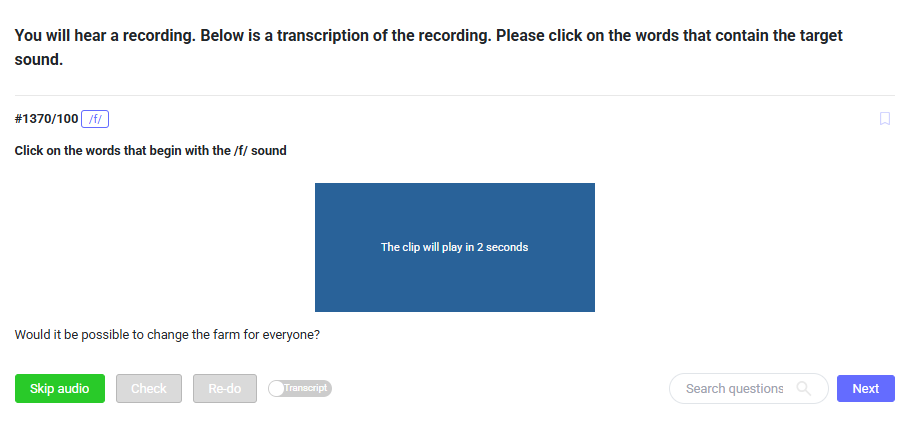
Với Identify the Sound, hãy tập trung nghe xem /f/ xuất hiện ở đâu và phân biệt nó với những âm dễ nhầm, đặc biệt là /v/.
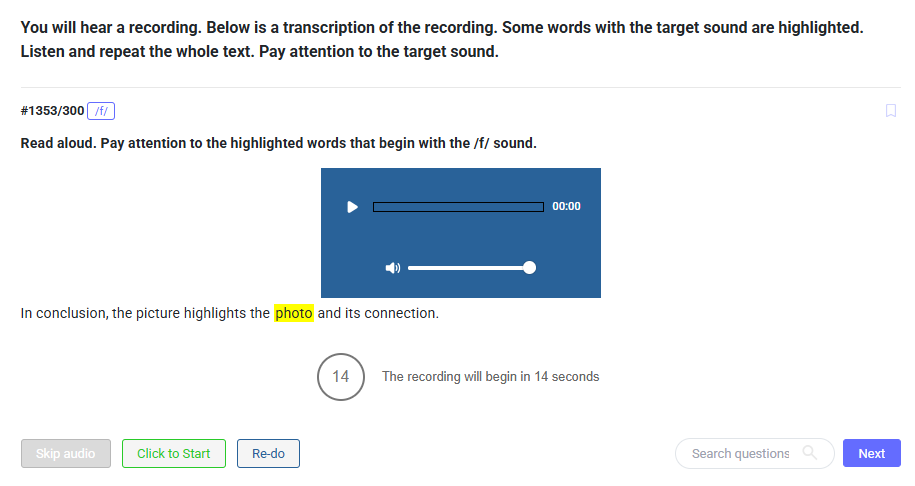
Sau đó, chuyển sang Practice the Sound để nghe mẫu và tự đọc lại. Khi thực hành, hãy kiểm tra ba điểm: môi dưới đã chạm nhẹ răng trên chưa, luồng hơi có đi liên tục không và cổ có vô tình rung khi tạo /f/ hay không.
Bạn có thể luyện theo nhịp:
Nghe mẫu → Nhận diện /f/ → Bắt chước → Kiểm tra → Sửa lại
Khi đã chắc /f/ đầu từ, hãy tăng dần độ khó với /f/ giữa từ → /f/ cuối từ → cụm phụ âm chứa /f/. Cách chia nhỏ này giúp bạn nhận ra chính xác vị trí nào đang khiến mình gặp khó khăn thay vì chỉ đọc thật nhiều từ liên tục.
Ngoài nội dung phát âm, PTEUNI còn hỗ trợ người học củng cố từ vựng, ngữ pháp và các kỹ năng cần thiết cho quá trình luyện PTE, giúp việc xây nền tiếng Anh và luyện thi được kết nối với nhau.
👉 Học viên PTE Helper có thể vào PTEUNI → Skill Booster → Identify the Sound/Practice the Sound để tiếp tục thực hành âm /f/: Truy cập PTEUNI
Khi mới luyện /f/, đừng cố tạo tiếng thật mạnh. Hãy ưu tiên đúng ba yếu tố: răng trên chạm nhẹ môi dưới, hơi đi đều và dây thanh không rung. Sau khi giữ được khẩu hình ổn định ở từ đơn, hãy chuyển dần sang từ có /f/ cuối, cụm phụ âm rồi mới luyện trong câu.
PTE Helper sẽ tiếp tục đồng hành cùng bạn trong quá trình xây nền phát âm và chuẩn bị tốt hơn cho mục tiêu PTE.
Bạn có thể xem thêm:
- Hướng dẫn phát âm âm /d/ chuẩn trong tiếng Anh
- Hướng dẫn cách phát âm 44 âm tiếng Anh theo bảng IPA
- Các quy tắc phát âm tiếng Anh quan trọng cần ghi nhớ
- 3 bài tập khẩu hình đơn giản giúp luyện phát âm hiệu quả tại nhà
- PTE Pronunciation – Khóa học phát âm chuyên sâu dành cho người học PTE
How to Pronounce /f/ in English: The Correct Mouth Position for Beginners
The /f/ sound is not completely unfamiliar to Vietnamese speakers because we have a somewhat similar sound in words such as “phim” and “phở.” However, in English, /f/ can occur in more positions, especially at the end of words and in consonant clusters. This is also where learners may have difficulty producing a clear /f/ or may replace it with another sound.
First, pronouncing /f/ as /h/ because the teeth do not touch the lips. If both lips remain apart and the upper front teeth do not touch the lower lip, the airflow escapes freely and produces only a light breathy sound similar to /h/. As a result, fat /fæt/ may sound like hat /hæt/.
Second, pronouncing /f/ as /p/ because both lips are closed. Instead of allowing the air to pass continuously through the narrow gap between the lips and teeth, learners may close both lips to finish the word with a /p/ sound. For example, cuff /kʌf/ may sound like cup /kʌp/, while leaf /liːf/ may sound similar to leap /liːp/.
Third, pronouncing /f/ as /v/ by vibrating the vocal folds. The mouth position for /f/ and /v/ is almost identical, but /f/ is voiceless whereas /v/ is voiced. If you accidentally produce vocal-fold vibration, fan /fæn/ may sound like van /væn/, and fine /faɪn/ may sound like vine /vaɪn/.
Fourth, dropping or weakening /f/ too much at the end of a word. Words such as life, half, roof, and safe may become less clear if the speaker stops immediately after the vowel without maintaining the fricative component of /f/.
Fifth, adding a vowel when /f/ occurs in a consonant cluster, for example, pronouncing free as something like “fuh-ree.” This changes the rhythm and syllable structure of the word.
In PTE Speaking, Pronunciation is assessed based on how clearly and intelligibly vowels, consonants, and the overall speech are produced. At the highest level, Pearson describes the requirement as all vowels and consonants being produced in a way that can be easily understood by a typical English speaker.
In this article, you will learn about /f/ from three main perspectives:
- Mastering the correct /f/ mouth position: Learn where to place your teeth and lips, how the airflow should move, and how to check whether your vocal folds are vibrating.
- Recognizing /f/ in words: Become familiar with the common spellings that represent /f/ and the different positions where the sound can occur in a word.
- Putting your knowledge into practice: Practice listening to, distinguishing, and producing /f/ with Skill Booster on PTEUNI.
1. Introduction to the /f/ Sound
/f/ is a voiceless consonant, meaning that the vocal folds do not vibrate when you produce it.
It is also a fricative. When producing /f/, the upper front teeth and lower lip form a narrow gap that allows the airflow to pass continuously, creating friction.
2. How to Produce the /f/ Sound
You can practice the /f/ mouth position in four steps:
- Step 1: Relax your jaw and bring your lower lip gently into contact with the edge of your upper front teeth. There is no need to bite your lip.
- Step 2: Keep the contact very light—just light enough for air to pass through the gap between your teeth and lip. If you press too hard, the airflow will be completely blocked and the sound will not be produced properly.
- Step 3: Push the air out continuously and evenly through the point of contact to create friction: /fffffff/.
- Step 4: Keep your vocal folds from vibrating throughout the entire process.
The quickest way to check your position is to feel the upper front teeth touching your lower lip. If you can clearly feel this point of contact, your /f/ production is heading in the right direction.
Next, watch the pronunciation video from the PTE Helper teaching team and follow each movement step by step to check whether your teeth and lips are positioned correctly.
3. Recognizing /f/ Through Spelling
The most familiar spelling for /f/ is f, but it is not the only one. The /f/ sound can also be represented by ff, ph, and, in some words, gh.
When the Letter “f” Is Pronounced /f/
The /f/ sound can occur at the beginning, middle, or end of a word:
- Beginning: fan, fine, fish, food, face, family, famous, future, follow, first
- Middle: before, after, perfect, prefer, profile, refer, useful, careful
- End: if, leaf, roof, safe, life, half, chief, proof, self, golf
When practicing, focus on the actual sound of the word, rather than simply looking at where the letter f appears.
When “ff” Represents /f/
The two letters ff usually represent just one /f/ sound:
- coffee /ˈkɒfi/
- office /ˈɒfɪs/
- offer /ˈɒfə(r)/
- effect /ɪˈfekt/
- different /ˈdɪfrənt/
- difficult /ˈdɪfɪkəlt/
- cliff /klɪf/
- stuff /stʌf/
You do not need to pronounce /f/ twice simply because you see two fs.
When “ph” Is Pronounced /f/
ph is a very common spelling for the /f/ sound, particularly in words of Greek origin:
- phone /fəʊn/
- photo /ˈfəʊtəʊ/
- phrase /freɪz/
- physics /ˈfɪzɪks/
- pharmacy /ˈfɑːməsi/
- elephant /ˈelɪfənt/
- alphabet /ˈælfəbet/
- graph /ɡrɑːf/
When “gh” Is Pronounced /f/
Some familiar words contain gh, but this spelling is pronounced /f/:
- laugh /lɑːf/
- cough /kɒf/
- rough /rʌf/
- tough /tʌf/
- enough /ɪˈnʌf/
However, gh is not always pronounced /f/. In many words such as light, night, and though, gh does not represent the /f/ sound. Therefore, these words are best learned together with their pronunciation and spelling rather than by applying this as an absolute rule.
A Very Common Exception: “of”
Do not automatically assume that the letter f is pronounced /f/.
In the word:
of /ɒv/
the letter f is pronounced as /v/.
Compare:
off /ɒf/ → /f/
of /ɒv/ → /v/
This is a very useful pair for practicing the difference between the two sounds.
4. Important Notes About the /f/ Sound
1. /f/ and /v/ Mainly Differ in Voicing
The two sounds have a very similar place of articulation:
Upper front teeth + lower lip
However:
/f/ → voiceless
/v/ → voiced
You can practice with these minimal pairs:
fan /fæn/ – van /væn/
fine /faɪn/ – vine /vaɪn/
safe /seɪf/ – save /seɪv/
leaf /liːf/ – leave /liːv/
With the final two pairs, the difference is not limited to the consonant. The vowel also tends to be longer before the voiced consonant /v/. Therefore, in natural speech, listeners rely on multiple acoustic cues to distinguish the words.
2. Do Not Add “fuh” Before a Consonant Cluster
/f/ can occur alongside other consonants:
free /friː/
friend /frend/
fly /flaɪ/
from /frɒm/
Do not separate the consonants as:
❌ “fuh-ree”
✅ free /friː/
When practicing free, you can hold the /f/ slightly longer and then move directly to /r/:
ffff-riː → free
Do not insert a vowel between the two consonants.
In final position, you may also encounter clusters such as:
left /left/
soft /sɒft/
laughed /lɑːft/
For these clusters, practice slowly to make sure you produce all the sounds before gradually increasing your speed. Research on Vietnamese speakers suggests that complex consonant clusters tend to be simplified by omitting some of their components.
3. You Do Not Need to Bite Your Lip Hard to Make /f/ Clearer
Simply let the edge of your upper teeth gently touch your lower lip.
If you bite too hard:
- the airflow becomes difficult to maintain evenly;
- your lips may become tense;
- and the sound becomes difficult to sustain.
Try:
/fffffff/
If you can hold the /f/ sound steadily for a few seconds without interruption, your mouth position is likely on the right track.
5. Practicing the /f/ Sound on PTEUNI
With Skill Booster on PTEUNI, you can practice through two main activities.
For Identify the Sound, focus on listening for where /f/ occurs and distinguishing it from easily confused sounds, especially /v/.
Then move on to Practice the Sound to listen to the model pronunciation and repeat it yourself. During practice, check three things: whether your lower lip is gently touching your upper teeth, whether the airflow is continuous, and whether your throat is accidentally vibrating when you produce /f/.
You can follow this practice sequence:
Listen to the model → Identify /f/ → Imitate → Check → Correct
Once you are confident with /f/ at the beginning of words, gradually increase the difficulty by moving to /f/ in the middle of words → /f/ at the end of words → consonant clusters containing /f/. Breaking the practice down this way helps you identify exactly where you are having difficulty instead of simply reading a large number of words continuously.
In addition to pronunciation practice, PTEUNI also supports learners in strengthening their vocabulary, grammar, and other skills needed for PTE preparation, helping connect English foundation building with exam preparation.
👉 PTE Helper students can go to PTEUNI → Skill Booster → Identify the Sound/Practice the Sound to continue practicing the /f/ sound: Access PTEUNI
When you are just starting to practice /f/, do not try to make the sound excessively strong. Prioritize these three elements: your upper teeth gently touching your lower lip, steady airflow, and no vocal-fold vibration. Once you can maintain a stable mouth position in individual words, gradually move on to words ending in /f/, consonant clusters, and finally sentences.
PTE Helper will continue to support you as you build a stronger pronunciation foundation and prepare more effectively for your PTE goals.















 Đăng ký tư vấn ngay